Digital transformation is one of the top priorities for many accounting and bookkeeping firms, but not everyone agrees on the best way to get there.
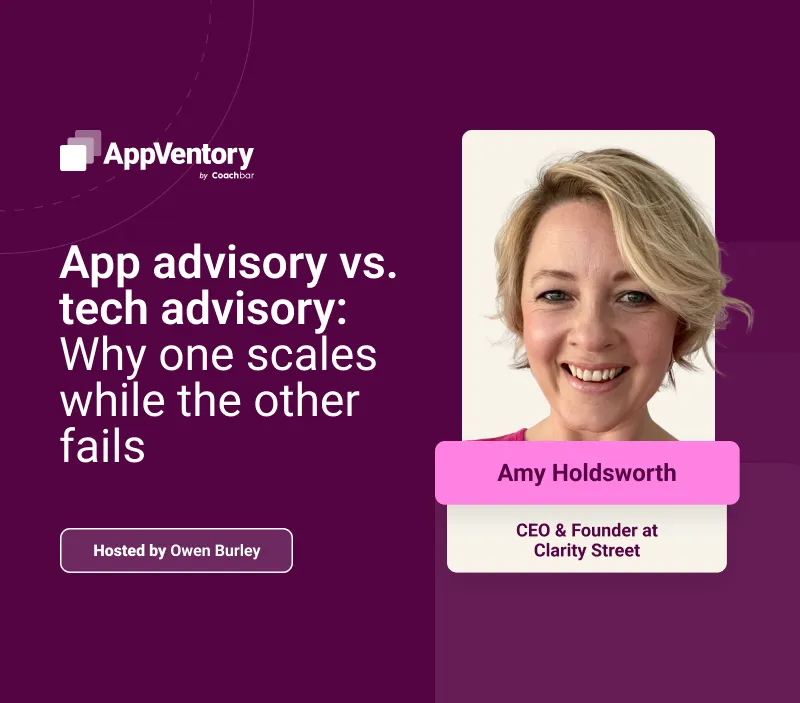
In a recent webinar hosted by AppVentory, Owen Burley sat down with Amy Holdsworth, CEO of Clarity Street, to unpack the differences between app advisory vs. tech advisory, and definitively answer why one scales, while the other often fails.
With over 15 years’ experience in change management and implementation, Amy didn’t hold back. In her opinion, there’s a clear winner, and it’s not even close!
Here’s a breakdown of the key insights from their conversation and what it means for firms thinking about advisory.
App advisory vs. tech advisory: Who wins?
The first topic of debate was answering the age-old question, which is better, app advisory or tech advisory?
To Amy, the distinction is often more about language than practice.
“If I had to really get specific about it,” she said, “I’d say tech advisory is broader. It goes deeper into how things work together, while app advisory feels more surface level, here’s an app, and here’s what it does.”
Owen offered another angle:
“App advisory is often the first step in advisory, which is focused on helping clients choose new or better tools. Tech advisory, on the other hand, is about end-to-end implementation. It’s more strategic. More sophisticated. And yes, more time-consuming.”
In practice, the terms can get blurred. But the level of depth you’re providing is what really matters. So for the firms who focus only on app advisory services, chances are, you’re only scratching the surface of what advisory can do for your firm and your clients.
Why firms struggle with advisory
When it comes to advisory struggles, Amy didn’t mince her words: “I don’t actually think the majority of accountants out there have any business doing advisory, whether it’s compliance, tech, or app, because most can’t get their basics done.”
Her point? You need to have your house in order before you start giving advice to others. Otherwise, you risk falling into common traps when branching out into advisory for the first time, such as:
- Recommending apps based on what’s easiest for you, instead of what’s best for the client.
- Failing to understand the client’s full operational process, not just the accounting side.
- Underestimating the time it takes to successfully implement new tech, and undercharging as a result.
- Trying to bolt it onto someone’s existing role, without giving them the time or support to succeed.
The result? A lot of half-baked projects, stressed out teams and coworkers, and frustrated clients.
Related: Tech Advisory Pricing: Must-Know Quoting and Negotiation Strategies
So, what does good advisory look like?
The firms that are nailing their advisory offeirings all have a few things in common.
- They’ve defined their services clearly. They know exactly what they do, who they serve, and what apps they work with.
- They’ve picked a niche. That means their team sees the same client types and tools repeatedly, which builds confidence and expertise.
- They’ve given it structure. The best firms don’t treat advisory as an afterthought. They’ve built a separate team or carved out proper time and scope to allow team members to deliver their best work.
- They aren’t afraid to charge for it. Whether it’s a one-off app stack strategy session or a full discovery and implementation process, they know their time has value, and so do their tech advisory clients.
In Amy’s words: “We got tired of giving away advice for free. Now we run strategy sessions. It’s 90 minutes, recorded, and the client gets a few takeaways they can action, or come back for help. But either way, we’ve been paid for our time.”
Related: [Free Checklist] 10 steps to scope app advisory opportunities faster
How to turn free advice into scalable services
Most firms start small by helping clients here and there whenever they need it. Sometimes, that means recommending a better app and other times, it’s about helping a client migrate to the cloud.
But effectively scaling your advisory services requires fundamentally changing your approach to advisory and how you think about it.
Amy recommends starting with these steps:
- Define your offering. What are you actually providing? For whom? Which apps?
- Charge for tech discovery. Just like with new accounting clients, you won’t know the scope until you get under the hood.
- Build capacity. If you’re expecting someone to handle advisory, don’t also expect them to hit compliance targets. Make room, or hire specifically for the role.
- Be transparent. Let clients know when you’re still learning, and never overpromise. That phrase “underpromise and overdeliver” is especially true here, and “foundational customers” will often appreciate your honesty.
Crucially, stop trying to be everything to everyone.
“When we started, we were jack of all trades, master of none,” Amy shared. “Now, we focus only on accounting firms. And that’s where we’ve found real traction.”
Are you ready to give clients what they need?
Amy likened the shift to advisory to the current buzz around AI. “You don’t need to know everything. But you do need to understand how it can be used, and either build the skills or the relationships to support it.”
As more and more clients realize the value of advisory, they WILL ask about it. But not all will be willing to pay for it, and that’s fine.
But as Amy said: “Stop giving away free advice to clients who don’t value it.”
At the same time, firms that are just getting started in advisory should try to avoid being too transactional about it as it can come off the wrong way, or even alienate clients who are interested in your services.
Instead, it’s better to approach client questions as if they’re opening the door to a deeper conversation about advisory, with the possibility of being upsold on your firm’s services. In essence, it’s less about not giving away free advice, and more about educating clients on the immense value they could get from your advisory services.
But whether it’s building in-house capability or partnering with specialists, the opportunity is there. And it’s growing. The question is, will you scale with it?
How’s your firm approaching digital transformation? Are you charging for the value you’re already delivering?